

The Complete Guide to
Durian Farming
Soil, climate, planting, care, pests, harvesting, and profitability — everything a durian grower needs to know.
Durian farming is one of the most rewarding — and most demanding — forms of tropical agriculture. The durian tree (Durio zibethinus) is uncompromising in its requirements: the wrong soil, the wrong rainfall pattern, or the wrong altitude can doom an orchard before it ever produces a single fruit. But when the conditions are right and the orchard is well managed, a mature durian grove is extraordinarily profitable, producing fruit that commands some of the highest prices of any commercially grown tropical crop in the world.
This guide covers the entire durian farming lifecycle, from land selection and soil preparation through to harvest, post-harvest handling, and the economics of building a viable operation. Whether you are a first-time grower evaluating land, an existing farmer looking to upgrade your management practices, or an investor assessing the durian industry, this is your complete reference.
1. Where Does Durian Grow? Climate, Elevation, and Site Selectiom
The single most important decision in durian farming is choosing the right site. Durian is native to the rainforests of Borneo and Sumatra and evolved under specific climatic conditions that it has never fully abandoned. Replicating those conditions as closely as possible is the foundation of a successful farm.
Ideal Climate Requirements
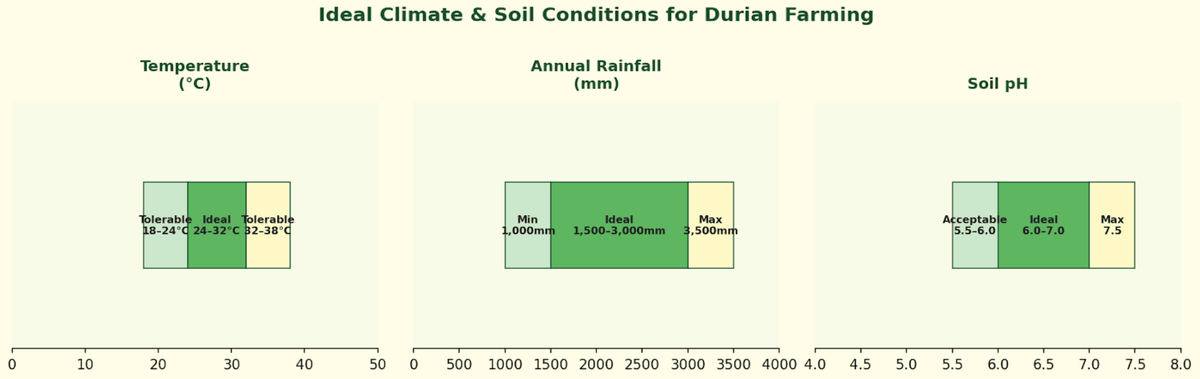
Fig. 1 — Ideal temperature, rainfall, and soil pH ranges for commercial durian cultivation.
- Temperature: 24°C–32°C is the optimal daytime range. Durian tolerates temperatures as low as 18°C and as high as 38°C but prolonged exposure outside the ideal band reduces yield and fruit quality.
- Rainfall: 1,500–3,000mm annually, well-distributed throughout the year. Crucially, durian needs a brief dry spell of 2–4 weeks to trigger flowering. Without it, flowering may be erratic or suppressed.
- Humidity: High relative humidity (70–80%+) supports growth. Excessively dry air causes stress and poor fruit development.
- Elevation: Below 600m above sea level for best results. Above 800m, temperatures drop too far for reliable flowering.
- Wind: Durian is highly wind-sensitive. Young trees and ripe fruit are both vulnerable. Choose sheltered sites or establish windbreaks on exposed boundaries.
The Importance of the Dry Spell
One of the most counter-intuitive aspects of durian cultivation is that it needs stress to flower. A period of 2–4 weeks with reduced rainfall — not a full drought, but a clear reduction in water availability — is the biological trigger that causes the tree to initiate flower bud formation. In regions with a reliable annual dry season (as in parts of Peninsular Malaysia and Thailand's eastern provinces), this happens naturally. In areas of more even rainfall, farmers sometimes deliberately restrict irrigation to simulate the dry spell. Getting this timing right is one of the most critical and high-skill aspects of durian orchard managememt.
Key Insight: The dry spell is not a problem to solve — it is a management tool. Experienced durian farmers time their irrigation schedules to create and break the dry period, effectively controlling when their trees flower and, by extension, when they harvest.
Soil Requirements
- Soil type: Deep, well-drained loam or sandy loam is ideal. Clay-heavy soils that waterlog are extremely damaging — waterlogging causes rapid root rot and tree death.
- pH: 6.0–7.0 is the target range. Below 5.5, micronutrient deficiencies become problematic. Above 7.5, iron and manganese become unavailable.
- Organic matter: High organic matter content improves water retention, drainage, and microbial activity. Soils that are naturally rich in organic matter, such as those under secondary forest, are excellent starting conditions.
- Drainage: If natural drainage is inadequate, raised beds or planting mounds 60–90cm high are essential. The investment in drainage infrastructure repays itself many times over in tree survival and productivity.
2. Choosing Your Variety: Which Durian Clone to Plant
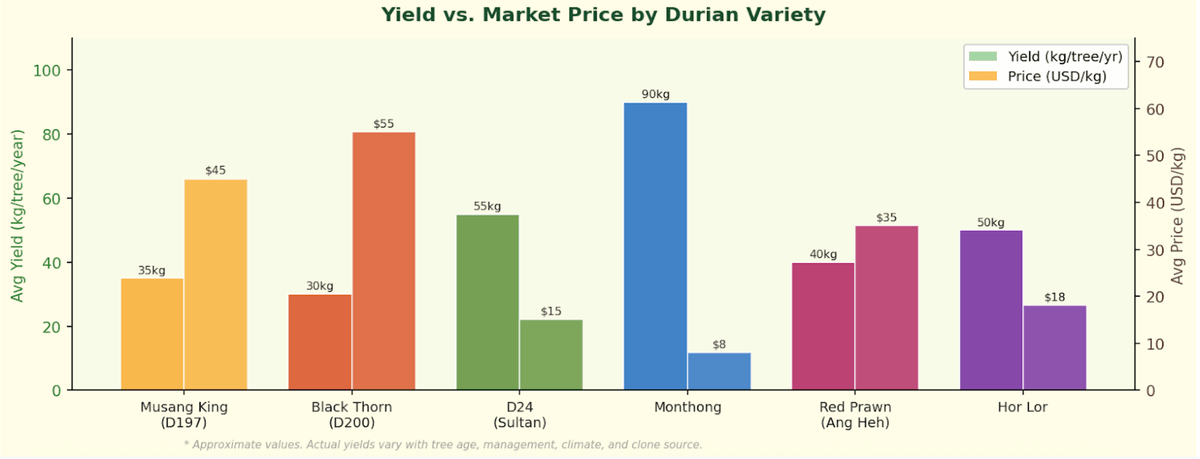
The variety decision is the most consequential financial choice a durian farmer makes. It determines your market, your price, your labour intensity, and your time to first commercial harvest. Here is how to evaluate the main options.
Fig. 2 — Average yield (kg/tree/year at peak production) vs. approximate market price (USD/kg) for the main commercial durian varieties.
Musang King (D197) — Maximum Value, Maximum Demand
Musang King remains the most commercially valuable durian in the world. The combination of its unmistakable flavour profile, its deep golden flesh, and a sustained surge in Chinese market demand has made it the flagship crop for premium Malaysian orchards. The trade-off is that Musang King is a relatively low-yielding variety (averaging 35–50kg per tree per year at peak) and requires meticulous care. It is also highly susceptible to Phytophthora root rot if drainage is substandard. For a high-investment, high-return operation targeting export, it is the benchmark choice.
Monthong — High Volume, Lower Risk
Monthong is the world's most commercially farmed durian variety by volume. It yields 80–100kg per tree per year at maturity — more than double Musang King — and is significantly more tolerant of variation in soil and climate. The price per kilogram is much lower (USD 6–10 vs. USD 35–55 for Musang King), but the volume advantage and lower management intensity make it highly profitable for large-scale operations. Thailand's dominance in global durian export is built almost entirely on Monthong.
Black Thorn (D200) — The Rising Premium
Black Thorn is increasingly sought-after by connoisseurs and commands prices comparable to or exceeding Musang King. Its orange-tinted flesh and complex flavour have created a growing premium market, particularly in Singapore, Hong Kong, and China. However, Black Thorn is even more demanding to grow than Musang King, with a longer time to harvest (110–125 days post-pollination) and stricter soil requirements. For experienced growers with established premium market channels, it offers exceptional upside.
Mixed Planting Strategy
Many experienced commercial growers diversify across varieties — typically 40–60% premium clone (Musang King/Black Thorn) alongside 30–40% higher-yielding varieties (Monthong/D24) and a small percentage of speciality clones (Red Prawn, Hor Lor). This distributes risk across market segments, smooths harvest timing across a longer season, and provides cash flow from higher-volume varieties while premium clones mature.
3. Planting and Establishment: Years 0-4
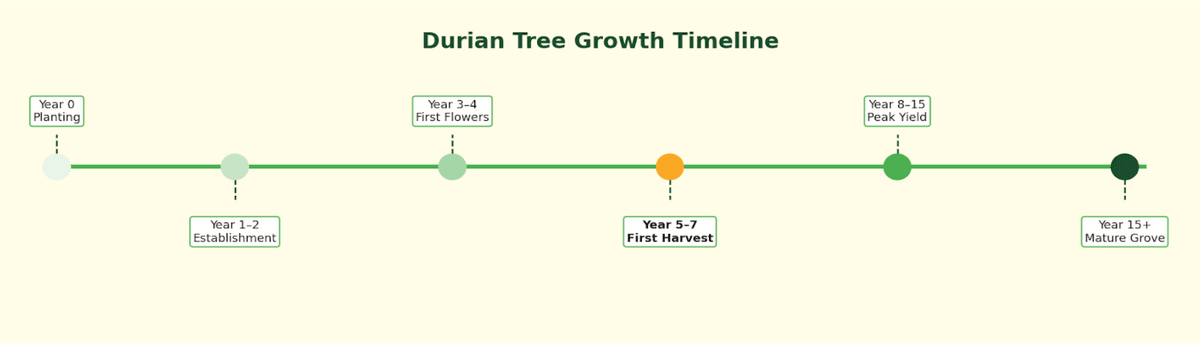
Fig. 3 — Durian tree growth timeline from planting to mature grove status.
Seedling vs. Grafted Clone: Which to Plant?
Always plant grafted clones from certified nurseries, never seedlings. Seedlings are genetically unpredictable — fruit quality, yield, and flavour will vary enormously from tree to tree, making it impossible to market consistently. Grafted clones from certified mother trees are true-to-type: every Musang King grafted tree will produce Musang King quality fruit. They also typically flower and bear fruit 2–3 years earlier than seedling trees, dramatically improving the economics of establishment.
Planting Layout and Spacing

Fig. 4 — Recommended 9m × 9m planting grid. Triangular offset layout improves airflow and sunlight penetration.
- Standard spacing: 9m × 9m for most varieties. This accommodates approximately 123 trees per hectare.
- Dense planting (6m × 6m): Used for some operations with plans to thin out after initial fruiting. Increases short-term yield but requires more aggressive pruning and increases disease risk.
- Triangular offset: Planting in offset rows rather than a strict grid increases airflow and light penetration, reducing disease pressure and improving fruit development.
- Windbreaks: Establish a double row of fast-growing trees (banana, bamboo, or Leucaena) on prevailing wind sides before or at the same time as durian planting.
Planting Process
Prepare planting holes 60cm × 60cm × 60cm minimum. In heavy soils, raise mounds to 60–90cm above ground level.
- Backfill with a mixture of topsoil, compost, and a small amount of rock phosphate to stimulate root development.
- Plant during the onset of the wet season to reduce irrigation demand during establishment.
- Water daily for the first 2–4 weeks. Gradually reduce to every 2–3 days as the tree establishes. Mulch heavily around the base to retain soil moisture and suppress weeds.
- Install a shade structure (50% shade netting) above young trees for the first 3–6 months. Direct tropical sun on immature root systems causes severe stress.
4. Orchard Management: Fertilising, Pruning, and Irrigation
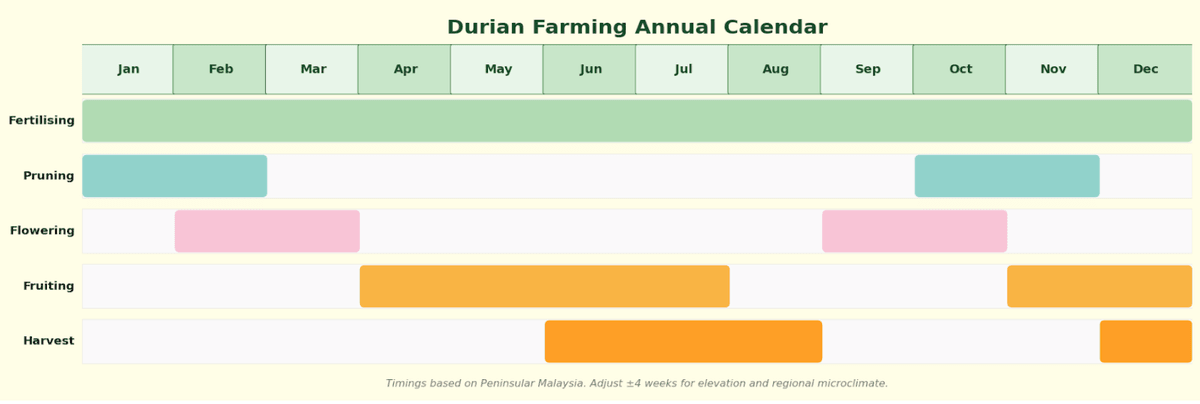
Fig. 5 — Annual durian farming calendar. Timings based on Peninsular Malaysia; adjust for local climate.
Fertilisation Programme
Durian is a heavy feeder. A well-structured fertilisation programme is one of the most direct levers on yield and fruit quality. The general framework consists of four phases:
- Phase 1 — Vegetative growth (young trees, Year 0–3): High nitrogen to drive canopy development. Typical NPK ratio: 15:15:15 or 20:10:10. Apply every 3 months.
- Phase 2 — Pre-flowering (mature trees, dry spell period): Reduce nitrogen, increase potassium and phosphorus to support flower initiation. Typical NPK: 12:12:17 or similar high-K formulation.
- Phase 3 — Fruit development: Maintain potassium and phosphorus. Add micronutrients, particularly boron and zinc, which are critical for seed formation and flesh quality.
- Phase 4 — Post-harvest recovery: Nitrogen-forward feeding to restore canopy and replenish energy reserves after fruiting. Critical for the following year's performance.
Best Practice: Soil and leaf tissue tests every 1–2 years are the most reliable way to identify deficiencies and optimise your fertilisation programme. Generic schedules leave money on the table — precision nutrition drives yield directly.
Irrigation Management
Mature durian trees in well-established orchards draw on deep root systems and tolerate periods of natural rainfall fluctuation. Young trees (Years 0–3) require consistent irrigation. Drip irrigation is the recommended system for commercial operations — it delivers water directly to the root zone, reduces leaf wetness (lowering disease risk), and enables fertigation (delivery of liquid fertilisers through the irrigation lines).
As discussed, the deliberate management of irrigation to create and break the dry spell that triggers flowering is one of the most advanced and highest-value skills in durian agronomy. Most experienced growers gradually reduce irrigation frequency over 2–4 weeks to create water stress, then resume normal irrigation once bud break is observed.
Pruning and Canopy Management
- Formative pruning (Years 1–4): Remove crossing branches, low-hanging branches below 1.5m, and any branches that grow vertically through the canopy centre. The goal is an open, vase-shaped canopy with 3–5 main scaffold branches.
- Maintenance pruning (annually, after harvest): Remove dead, diseased, and unproductive wood. Thin the canopy to maintain 50–60% light penetration to the interior.
- Fruit thinning: On high-bearing trees, thin fruits to 20–25 per tree to concentrate resources into fewer, larger, higher-quality fruits. This is standard practice for premium clone orchards.
5. Pests and Diseases: Identification, Prevention, and Control
Pest and disease management is the highest-risk area of durian farming. A single Phytophthora outbreak that goes undetected can kill a significant portion of an orchard within months. Proactive monitoring, good agronomic practices, and rapid response protocols are non-negotioable.
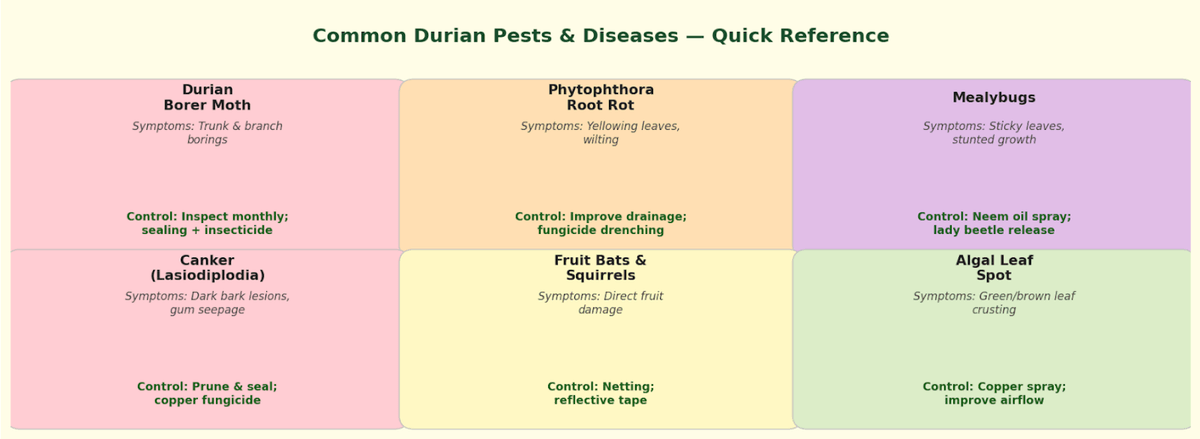
Fig. 6 — Quick reference guide to the most economically significant durian pests and diseases.
Phytophthora Root and Collar Rot — The Highest-Priority Threat
Phytophthora palmivora is the most economically devastating pathogen in durian farming. It is a water mould that thrives in wet, poorly drained soils, attacking the root system and trunk base. Symptoms include yellowing leaves, wilting on individual branches that spreads rapidly, and dark water-soaked lesions at the base of the trunk. Once a tree is severely infected, recovery is difficult.
- Prevention (most effective): Ensure excellent drainage. Raise planting mounds. Avoid waterlogging at any time, particularly during the wet season.
- Chemical control: Phosphonate fungicides (fosetyl-aluminium, potassium phosphonate) applied as trunk injections or soil drenches are highly effective when applied early. Metalaxyl-based fungicides are also used.
- Biological controls: Trichoderma-based products applied to the soil can establish competitive microbial populations that suppress Phytophthroa.
Durian Borer Moth (Mudaria luteileprosa)
The durian borer moth lays eggs in bark crevices, and the larvae bore into the trunk and main branches, creating tunnels that disrupt the vascular system and weaken the tree structurally. Signs include frass (excrement) pushed out from entry holes and visible tunnels in cut wood. Monthly inspections of trunks and branches, sealing entry holes with insecticidal paste, and trunk injections with appropriate insecticides are the standard response protocol.
Integrated Pest Management Philosophy
Modern durian orchards increasingly adopt Integrated Pest Management (IPM) frameworks — combining cultural controls (pruning for airflow, drainage management), biological controls (beneficial insects, microbial products), and targeted chemical applications only when pest or disease thresholds are exceeded. IPM reduces input costs, extends the effective life of chemical controls, and is increasingly required by premium export market buyers who conduct residue testing.
6. Harvesting Durian: Timing, Technique, and Post-Harvest Handling
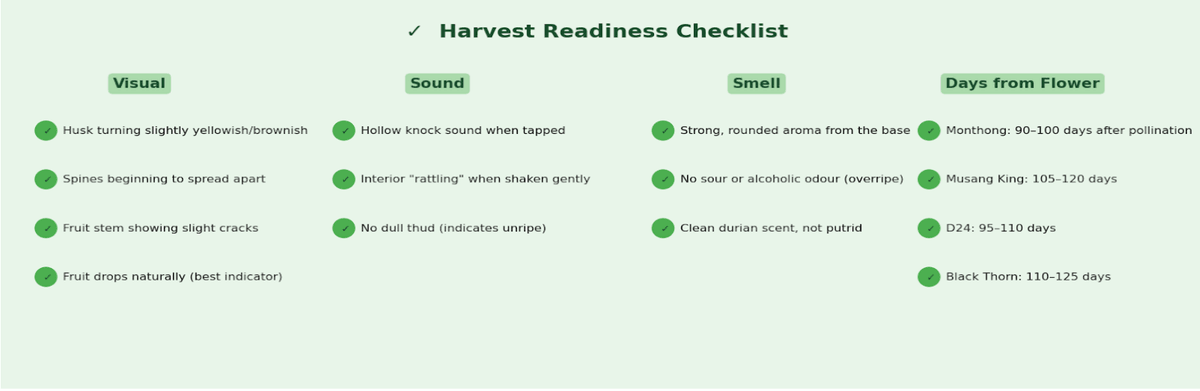
Fig. 7 — Harvest readiness checklist for commercial durian growers.
Natural Drop vs. Active Harvest
There are two approaches to harvesting durian, each with distinct quality and logistics implications:
- Natural drop: The tree is allowed to drop ripe fruit onto netting strung below the canopy. This produces fruit at peak ripeness — exactly when the tree releases it — and is the method preferred for local fresh markets and premium buyers who value optimum flavour.
- Active harvest (cutting): Fruit is harvested 3–5 days before natural drop by cutting the stem. This allows for transport over longer distances and to export markets. The trade-off is a big reduction in peak flavour, since the fruit continues ripening off the tree.
Post-Harvest Handling
- Sort by variety, grade, and maturity immediately after collection. Mixed-grade fruit dramatically reduces average selling price.
- Cold chain for export: Durian intended for export is typically frozen (−18°C) within 24–48 hours of harvest. Whole frozen durian and frozen durian flesh are both significant export categories, particularly to China.
- Packaging: Whole fruit is typically wrapped in foam netting and boxed. Flesh is packed into sealed trays or vacuum-sealed. Vacuum-sealed fresh flesh is a fast-growing premium product category.
- Shelf life: Fresh durian at ambient temperature is highly perishable — 2–4 days maximum from harvest. Refrigerated (2–5°C): 3–5 days. Frozen: 6–12 months if properly sealed.
7. The Economics of Durian Farming: Costs, Yields, and Profitability
Durian farming is a long-term investment with a distinctive cost and revenue profile: high establishment costs, zero revenue for the first 4–6 years, then rapidly increasing returns from Year 7 onwards as trees mature and yields climb. Understanding the full financial picture before planting is essential.
Establishment Costs (Per Hectare, Peninsular Malaysia Estimate)
- Land clearing and site preparation: MYR 8,000–15,000
- Drainage and earthworks (where needed): MYR 5,000–20,000
- Grafted planting material (123 trees at MYR 30–80/tree): MYR 4,000–10,000
- Irrigation system installation: MYR 8,000–18,000
- Labour, fertiliser, and materials (Years 0–4): MYR 30,000–50,000
Total establishment cost range: MYR 55,000–113,000 per hectare (approximately USD 12,000–25,000), before land cost.
Revenue Projection (Musang King, Per Hectare)
- Year 5–6 (first commercial harvest): ~10–20kg per tree × 123 trees = 1,200–2,400kg. At MYR 40/kg: MYR 48,000–96,000.
- Year 7–10 (growing production): ~25–35kg per tree = 3,000–4,300kg. At MYR 40–60/kg: MYR 120,000–258,000.
- Year 10–15 (peak production): ~35–50kg per tree = 4,300–6,150kg. At MYR 40–60/kg: MYR 172,000-369,000.
Profitability Note: A well-managed 1-hectare Musang King orchard at peak production (Year 10+) can generate MYR 150,000–350,000+ per year in gross revenue. Operating costs at maturity (fertiliser, labour, pest management) typically run MYR 30,000–60,000/ha/year, yielding substantial net margins for established operations.
Key Risk Factors to Model
- Price volatility: Durian farmgate prices fluctuate significantly with seasonal supply and export demand. Diversifying across varieties and having multiple market channels (fresh local, fresh export, frozen) reduces exposure.
- Disease events: A Phytophthora outbreak or pest infestation in Years 4–6 — just before first commercial harvest — is the worst-case financial scenario. Robust disease prevention programmes are a direct financial protection.
- Climate variability: El Nino years with extended drought or La Nina years with excessive rainfall disrupt flowering cycles and fruit development, sometimes eliminating an entire season's harvest.
- Labour: Durian farming is labour-intensive, particularly during harvest. Labour availability and cost in Malaysia have tightened significantly and this trend is expected to continue.
8. Technology in Durian Farming: What Smart Growers Are Doing Differently
Technology adoption in durian farming has accelerated sharply over the past decade, driven by quality-sensitive export markets and the need to manage labour costs. The most commercially significant developments include:
AI-Powered Variety Identification
Computer vision systems trained to identify durian varieties from images are being deployed at packing houses to prevent mislabelling — a serious problem given the price differential between varieties. Systems achieving 80%+ accuracy are in commercial operation, with ongoing improvements as training datasets grow. For export markets where Musang King commands a premium many times that of ordinary durians, the ability to verify variety at the point of packing is a significant quality assurance tool.
Near-Infrared (NIR) Ripeness Detection
Traditional ripeness assessment through tapping and listening is skill-dependent and error-prone. NIR spectroscopy-based assessment tools can measure internal starch content (the key ripeness indicator) non-destructively and with high accuracy, enabling more consistent grading and reducing post-harvest quality failures. Thai exporters have been particularly active in deploying these systems, and the technology is increasingly accessible to mid-sized operations.
Precision Fertigation and Sensor Nework
IoT soil moisture sensors, weather stations, and automated fertigation controllers allow growers to deliver water and nutrients precisely, responding to actual soil conditions rather than fixed schedules. This reduces input waste, improves consistency, and provides the data needed to manage the critical dry spell trigger with much greater precision. For premium clone operations where timing is everything, the investment in precision irrigation technology typically pays back within 1–2 productive seasons.
Drone Monitoring and Canopy Analysis
Drone-based multispectral imaging enables early detection of nutrient deficiencies, disease outbreaks, and irrigation stress across large orchard areas in a fraction of the time required for ground-level inspection. For orchards above 5 hectares, regular drone surveys are becoming standard practice among progressive operators.
Final Thoughts: Building a Durian Orchard That Lasts
Durian farming rewards patience, precision, and deep agronomic knowledge more than almost any other tropical crop. The trees that are planted today and managed with care will outlive most farm equipment, outlast most market cycles, and provide returns for 20, 30, or even 50 years. The decisions made in the first five years — variety selection, site preparation, drainage, clonal quality, and establishment practices — determine the ceiling of everything that follows.
The key principles that separate consistently profitable durian operations from struggling ones:
- Site first — no amount of management can overcome a fundamentally unsuitable site. Soil drainage is non-negotiable.
- Grafted clones only — varietal consistency is the foundation of premium market access.
- Drainage as infrastructure — treat it as seriously as the planting material itself.
- Learn the dry spell — mastering the flowering trigger is the single highest-leverage agronomic skill.
- Disease prevention over cure — particularly Phytophthora. The cost of prevention is a fraction of the cost of an outbreak.
- Technology as leverage — even small operations benefit from drip irrigation, soil testing, and data-driven management.
- Patience is the strategy — durian is a long game, and the returns at maturity are extraordinary for those who reach it.
Whether you are planting your first hectare or expanding an established grove, the durian industry offers exceptional long-term opportunity. The global appetite for high-quality durian — driven by a growing Southeast Asian middle class and an enormous and still-expanding Chinese market — continues to outpace supply for premium varieties. The orchards planted today are positioned to supply that demand for decades to come.